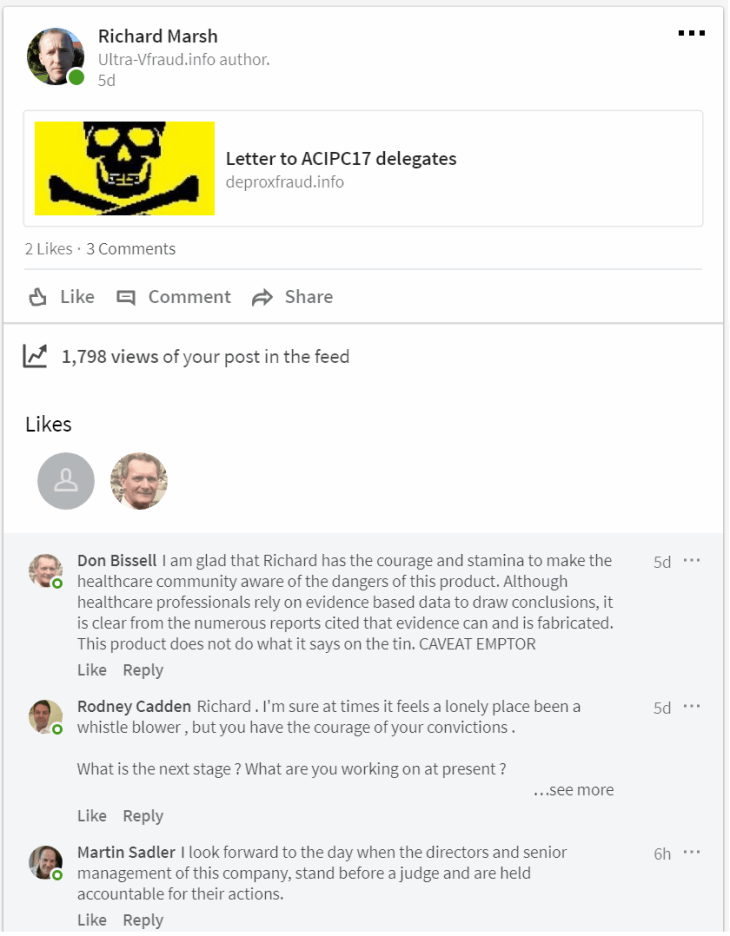
Letter to ACIPC17 delegates

A letter sent today to all 308 delegates to the 2017 Australasian Conference on Infection Prevention and Control.

Dear Delegate,

I wish to draw your attention to the presence of Hygiene Solutions Ltd at ACIPC17. This UK company presents a serious threat to healthcare providers in Australia and New Zealand . Extensive evidence from both published papers and from disclosures by former employees of the business has revealed numerous fraudulent practices and reckless and irresponsible actions by this company. One well documented example is a very substantial and clearly correlated step increase in C. difficile infections in the University College London Hospitals on the implementation of the Deprox system, followed by an equally clear decrease when this system was abandoned 2  and a half years later. Approximately 70 additional cases over baseline occurred over the 29 months of Deprox operation. See: https://www.linkedin.com/pulse/freedom-information-request-reveals-exact-c-richard-marsh/

In brief, the history of these issues is as follows:

In response to insoluble technical problems with residual H2O2 vapour, the system manufacturer, Specialist Hygiene Solutions Ltd, secretly and drastically cut the disinfectant vapour concentration settings on the entire fleet of almost 200 systems, leaving the process almost entirely ineffective against the deadly HCAI pathogens it was claimed to eliminate. See:

https://deproxfraud.info/2017/03/13/leaked-emails-prove-test-cheating-bodily-harm-and-massive-fraud/

Thus not only were tens of thousands of patients needlessly put at risk of debilitating and possibly fatal infections, but the health services of the UK,  Australia and New Zealand were defrauded of over £20,000,000.

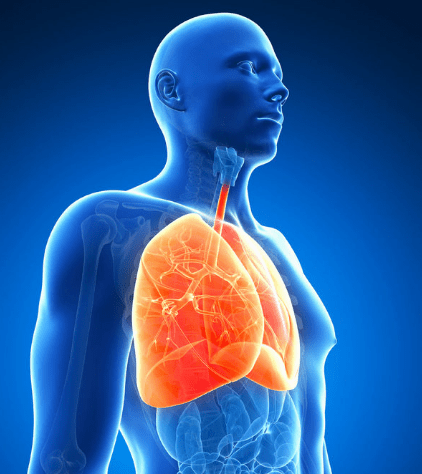
Further to this, the Deproxin solution contains silver nitrate, which is forbidden in the EU for fogging applications on account of its toxicity to lung tissue and mucous membranes. Several Deprox operators have suffered chronic respiratory illness as a result of being exposed to the residual fog after a room has been treated. These persons are actively seeking legal compensation for these injuries.

See: https://deproxfraud.info/2017/11/07/2-more-deprox-operators-hit-with-throat-and-lung-damage/

The UK market is now largely aware of the dangerous and fraudulent nature of Hygiene Solutions Ltd, which has crippled their sales prospects in that area – hence their presence at ACIPC17 in an attempt to open up the Australasian market.

My simple request is that any healthcare institution contemplating doing business with Hygiene Solutions Ltd should thoroughly research the health and safety, and the germicidal efficacy of the products offered.  Independent confirmation should be sought, as the directors of the company have no hesitation about fabricating evidence.

No less than 39 examples of these fabrications can be found here:

https://deproxfraud.info/deprox-fraud/

The Health and Safety Executive is leading an investigation in to Hygiene Solutions Ltd in the UK.  The officer coordinating the operation is Mr Martin Ball;

Martin Ball | HM Inspector of Health and Safety

CRD Compliance Team

Health & Safety Executive Chemicals Regulation Division

5S.1 Redgrave Court, Merton Road, Bootle, Merseyside, L20 7HS.

Tel: 0151 951 3512

martin.ball@hse.gov.uk

Summary of issues

  • The process is only capable of a small fraction of the claimed disinfection efficacy.
  • Rooms and equipment cleaned with Deprox remain dangerously contaminated with pathogens, and are a serious and potentially lethal threat to patients.
  • Residual chemicals of H2O2, AgNO3 and PbO are way in excess of legal limits and several operators have suffered permanent respiratory damage.
  • The fraud is accomplished by a complex and sophisticated web of misinformation, outright lies, rigged tests, and claiming test results from competitor’s machines as their own.
  • Healthcare providers in the UK, AU and NZ are being defrauded of tens of millions of pounds.

Sincerely,

Richard Marsh
http://www.deproxfraud.info

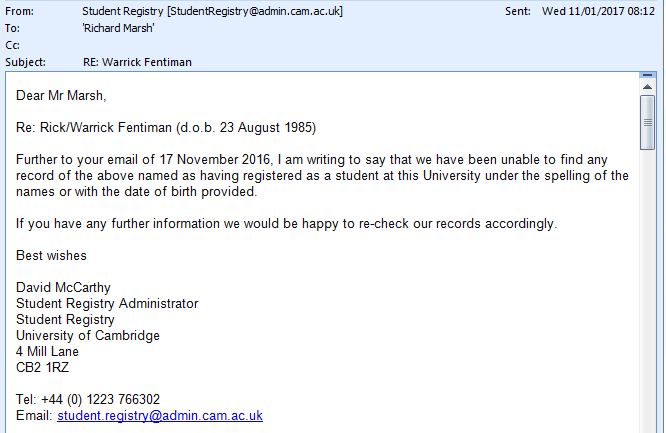
Rick fentiman


Response to my letter to #ACIPC17 Delegates, from an administrator within the North Sydney Local Health District

#acipc17


Hygiene Solutions posts fake email addresses at ACIPC17

Hygiene Solutions has two new e-publications for ACIPC17, these are in the Sponsor e-satchel section on the ACIPC17 app. ( https://guidebook.com/guide/102693/poi/8908501/ )

All but one of the website addresses given on these documents is fake:

www.hygienesolutionsau.com

www.hygienesolutionsnz.com

www.hygienesolutionsus.com

Only the UK website actually exists:
www.hygienesolutionsuk.com

wrong address


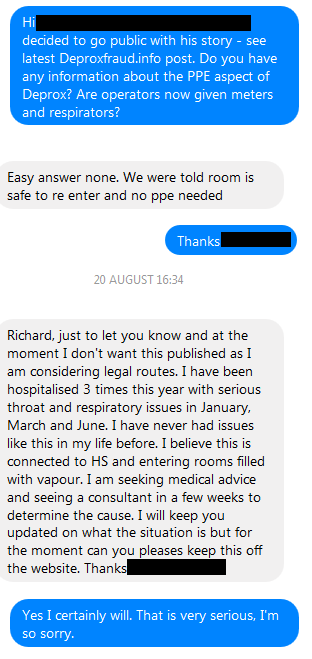
Two more operators…

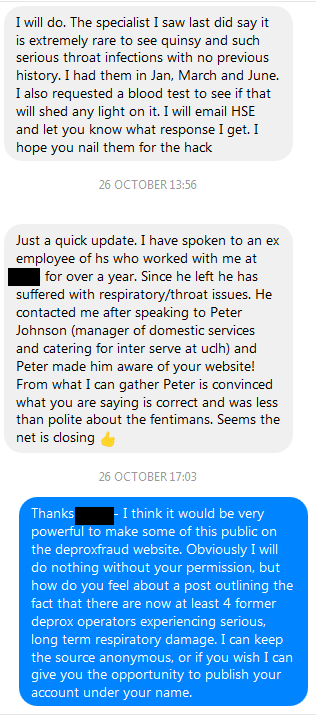
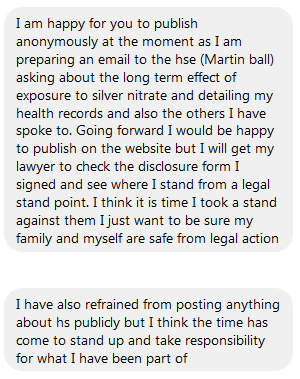
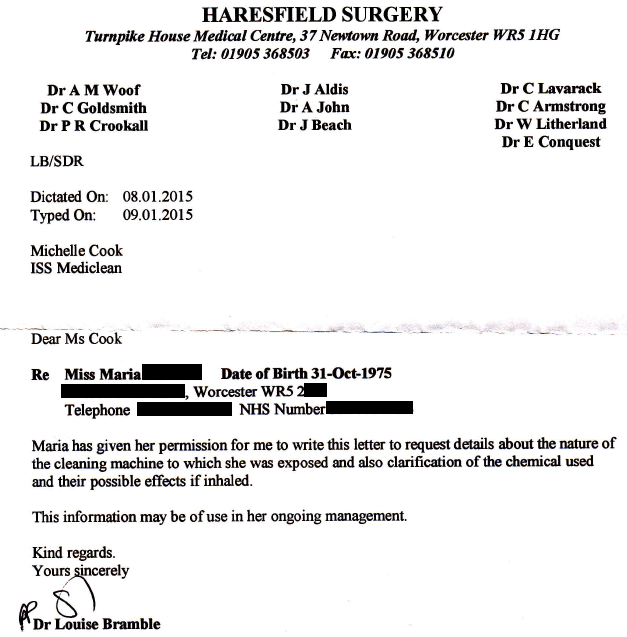
Exchange of messages between Richard Marsh and a former Deprox operator. This brings the total of Deprox operators suffering chronic respiratory damage to four – the two mentioned below, plus Gordon Cunningham, plus Maria Cardioso from Worcester.

For the background to this issue, see Toxic Legacy


Deprox 1

Deprox 2

Deprox 3

Deprox 4

Reproduced below is a doctor’s letter to Hygiene Solutions Ltd, requesting information  to assist in treating  Maria Cardioso, an ISS Mediclean hospital cleaner who was operating Deprox units in the Worcestershire Royal Hospital. This was in January 2015. The operators above were still operating Deprox in 2016 without PPE and without being warned by Hygiene Solutions Ltd about the danger of the silver nitrate in the Deproxin fog they were inhaling.

maria-cardoso

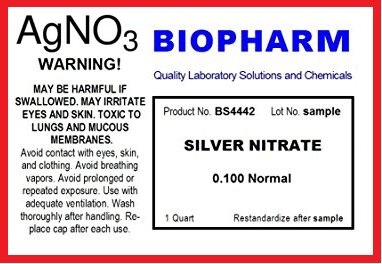
Standard safety label for Silver Nitrate specifically warning of toxicity to lungs and mucous membranes.

AgNO3

CANBERRA SHARK ATTACK!

Deprox hales acipc 2017

On 2nd February 2017, in response to publication of the whistleblower exposé of the Deprox fraud, Specialist Hygiene Solutions Australia Pty Ltd declared voluntary liquidation, and Australian Deprox distributor Acute Healthcare hastily dropped the product from its catalogue.

However, in order to to maintain product registration with the ARTG (Australian Register of Therapeutic Devices) Hygiene Solutions (UK) must have a registered Australian company as sponsor.

It has emerged that a second business, under the name Specialist Hygiene Solutions Australia has been created with a new ABN  – this is a partnership, rather than a limited company – and this new entity has taken over sponsorship of the Deprox and Deproxin products.

Unfortunately, Australian business practices are less than transparent, and short of legal action it is impossible to identify who the beneficial owners of this Australian partnership are. The only identity given is “The Trustee for the RS & HR family Trust and others”  Like Panamian bank accounts and Cayman Island investment trusts, this legitimised  anonymity is very convenient for individuals wishing to invest in unethical or fraudulent trading, as funds can be easily laundered through a web of interconnected Australian family trusts.

However, a search of the history reveals that the original name of “The Trustee for the RS & HR family Trust and others” was “THE TRUSTEE FOR RS & HR FAMILY TRUST & THE TRUSTEE FOR THE AT SITE SUPPLIES TRUST & THE TRUSTEE FOR THE HALES TRUST”

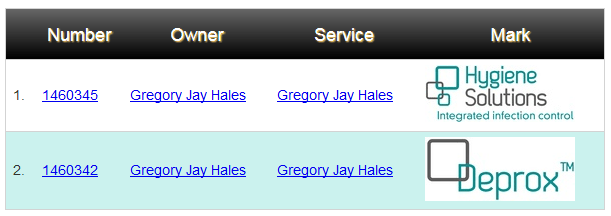
Furthermore, a search of Australian trademarks reveals the following:

Deprox 4

The  LinkedIn profile shows that  Gregory Hales was a director of At Site Supplies, and is currently the director of SafeSmart Access. Both SafeSmart Access and Hygiene Solutions limited share the same Sydney, NSW address.

SafeSmart Access

Deprox hales

It seems likely  therefore that the Australian Deprox operation is run by Gregory Jay Hales, a prominent member of the so called “Hales Exclusive Brethren” a highly controversial religious sect headquartered in Sydney, Australia.

Australian relaunch in Canberra

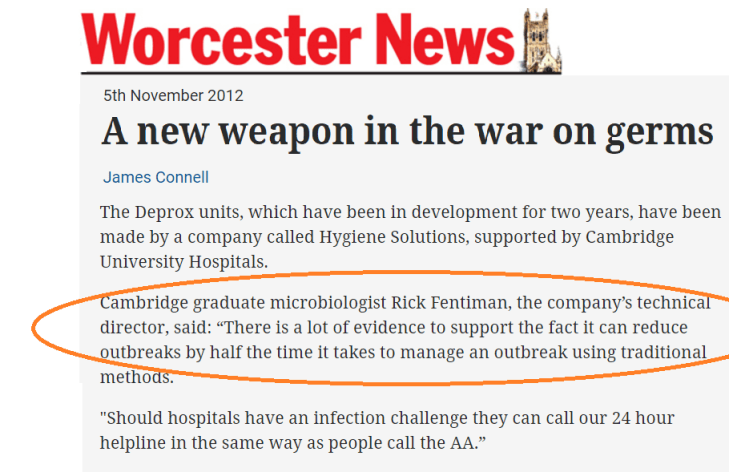
Rick Fentiman, Hygiene Solutions Ltd director and self-appointed “Cambridge University Microbiologist” will be exhibiting at the Australasian College of Infection Prevention and Control (ACIPC) exhibition in Canberra, 20-22 November 2017. He will doubtless be bringing his “Proxcide” Mk. III Deprox prototype, as well as the Deprox and Ultra-V systems to display.

Hygiene Solutions Ltd has also splashed out $10,300 to become a “Bronze Sponsor” of the ACIP exhibition, over and above the $6,600 for the booth. This level of investment suggests a major push in to the Australian market, and it is rumoured that the Fentimans may be relocating to Australia along with their business, thus evading a number of impending legal actions in the UK. Given Australia’s historic function as a penal colony, this move would seem to be entirely appropriate.

Deprox 1

Any hospitals considering these systems should first give sober consideration to the tragic experience of the UCLH hospital in London, where a C. difficile epidemic following the introduction of the Deprox system led to an estimated 12 deaths over a period of 3 years.


Anatomy of a cyber-attack

It is hard to operate in cyberspace without leaving a trail. The September 25th cyber attack on deproxfraud.info, and whistleblower Richard Marsh’s personal Facebook, Google, Gmail, Twitter, Dropbox, Vimeo, WordPress, YouTube and Twitter accounts shows a particularly grubby set of fingerprints that the Norfolk CID will doubtless be familiar with…

Richard Marsh is resident in Saskatchewan, Canada, and has been since January 2017. Thus when social media sites detected “persons unknown” logging in to the administration areas of his websites and pages from locations in Norfolk UK, they automatically sent out Security Alert emails to the page or website owner.

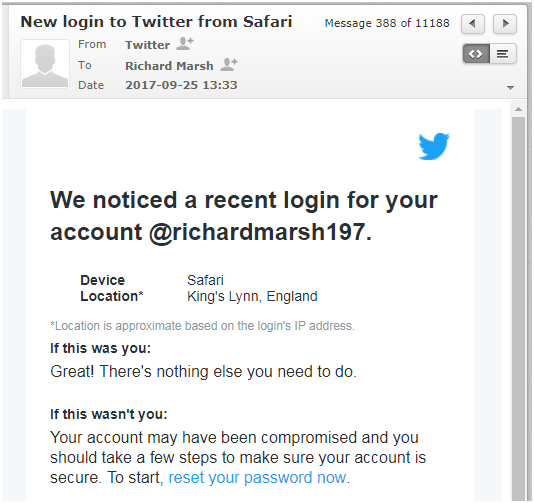
From the flurry of security alerts received on the 25th and 26th September, an exact timeline of the hacker’s activity can be constructed. Note that the email times are for Saskatchewan, which is 7 hours behind the UK. The hacker started by illegally accessing Richard’s Twitter account at 20.33 from a location in King’s Lynn, Norfolk. This generated the security alert below at 13.33 Saskatchewan time.

fentiman hack

September 25th, 2017

13.33 Twitter new login from King’s Lynn, Norfolk

13.40 Facebook password reset

13.47 Twitter password reset

13.54 Twitter email address changed

14.34 WordPress (deproxfraud.info) email address changed

15.22 Vimeo account deleted

15.23 Gmail account security alert: Sign in from a Blackberry device in the UK

18.31 Dropbox account accessed from Terrington St. Clement, Norfolk

19.33 New email address “rubbish@sasktel.net” added to LinkedIn account

September 26th, 2017

01.58 Romer Photonics Company page removed from LinkedIn

05.16 Facebook account login from Whittlesford, UK

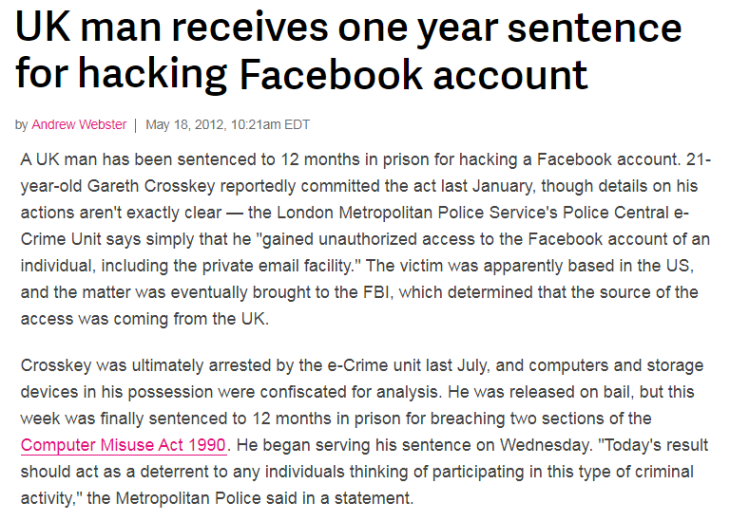
The directors of Hygiene Solutions Ltd and their partners in crime might like to contemplate the fate of young Gareth Crosskey, who was sentenced to a year in prison for hacking a Facebook Account.

fentiman hack facebook

Victory! Judge dismisses gagging order.

The Honourable Mr. Justice B.A. Barrington-Foote has dismissed Hygiene Solutions’ application to register a gagging order against Richard Marsh, and awarded costs to the applicant.

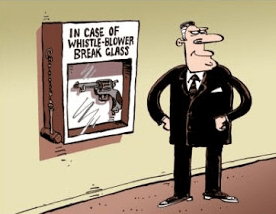
Canadian justice has thus defended the right of a whistleblower to speak out in defence of the life and health of hospital patients worldwide. The deproxfraud.info website will continue its exposure of the fraudulent and astonishingly ineffective Deprox and Ultra-V hospital decontamination systems and the criminal activities of Hygiene Solutions’ directors.

Justice.PNG

Justice

Whistleblower attacked…again.

Stung by the damning exposure of the Ultra-V’s incredibly poor performance against C. difficile (log0.1 – log1.1) Hygiene Solutions Ltd. director, Rick Fentiman made a further attack in the Regina Court of Queen’s Bench on Friday against whistleblower Richard Marsh.

Fentiman’s lawyer, F. William Johnson QC spoke for almost a hour, on the theme “Corporations have a right to defend their reputation.” Judge The Hon. Brian Barrington-Foote, was not persuaded, and has reserved judgement.

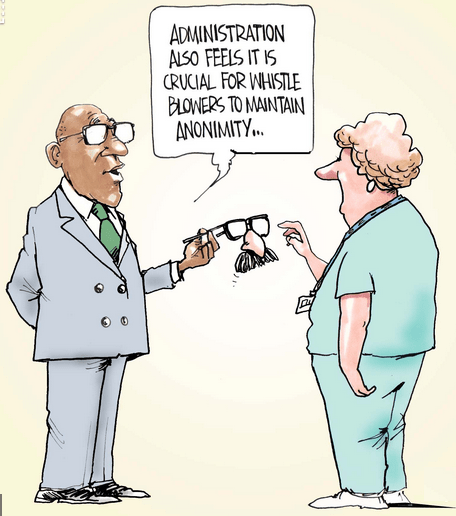
Fentiman is attempting to register a gagging order that would prevent Richard Marsh from disclosing any further information about “Hygiene Solutions Ltd, its directors, employees or Deprox product.”  As a precaution, Richard has put in place a comprehensive backup plan to ensure that deproxfraud.info continues to publish unhindered even if the gagging order is passed.

This contingency plan depends on the fact that the gagging order is specific to Richard Marsh, and limited in its scope to Saskatchewan. The first two elements in the plan have already been enacted:

  • The ownership of the website has been transferred to an anonymous third party in Asia.
  • The Editorship of the site has been transferred to Dr Ecosse, who is not a Canadian resident.

The final element, which will only be put in to effect should the gagging order be allowed, is to transfer authorship of the blog posts to Dr Ecosse. It should be noted that Dr Ecosse has very deep personal reasons of his own to take issue with Hygiene Solutions, he is in no sense acting as an agent, and is certainly not being remunerated for his efforts. Dr Ecosse is also exceptionally well qualified to review and comment on the fraudulent activities of Hygiene Solutions Ltd. from a medical and scientific standpoint.

Whistleblower3 Ultra-V

Once this final step has been taken, deproxfraud.info will continue to publish indefinitely without any input whatever from Richard Marsh, and Hygiene Solutions’ lawyers will have the interesting task of tracking down Dr. Ecosse, who may prove to be rather elusive…

Whistleblower Ultra-V


Gordon’s story

Deprox2

Gordon’s Story

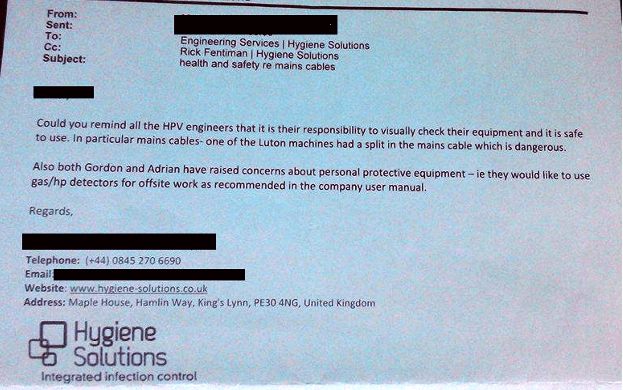
Gordon Cunningham started working for Hygiene Solutions early in 2013, building and servicing the Deprox machines, as well as operating the system in hospitals across the UK. He noticed that at the end of a decontamination process, the treated rooms often still had a visible white mist in the air, although the Deprox remote control light indicated that the room was safe to enter. He raised his concerns with company directors Rick and Mark Fentiman, but was told that there was nothing to worry about and that the process was entirely safe. Nonetheless, he requested a respirator and a hydrogen peroxide (H2O2) gas monitor (Draeger) to protect himself when using the Deprox, but his request was ignored.

Gordon, a non-smoker who keeps fit by running and triathlons, began to experience a tender sensation in his throat after being exposed to the Deprox residual vapour. These symptoms progressed to an asthma like feeling of a constricted airway and a hoarse cough.

The business owners, Rick and Mark Fentiman insisted that re-entering a treated room was safe, as long as the H2O2 level was below 5.5ppm. (In fact, the safe exposure level is 1ppm)

Gordon then spoke to the chemist who was working on the Deprox project, David Sempere Aracil. David told him that he should not be entering rooms at 5.5ppm.

In June 2014, Gordon was asked to spend 3 days operating the Deprox system at the Luton and Dunstable Hospital. Six months had passed since he requested a respirator but his request had not been responded to. When re-entering the rooms, he would try to cover his mouth and get the windows open as quickly as possible, to minimize his exposure. Gordon noticed one of the technicians had a new Draeger H2O2 meter, and he asked how it was operated. The technician explained how to use the meter, and how to set it so that it would sound an alarm buzzer until the gas concentration had dropped to a safe level. Gordon had done some research, so he knew the safe level was 1ppm. Gordon took the Draeger to Luton with him.

On Monday June 2nd 2014 Gordon had two rooms for Deprox treatment at the Luton and Dunstable Hospital. The first room was the equipment library. He set up a Deprox unit in this room, and 1 ½ hours later the green light on the Deprox remote control lit, indicating that the room was safe to enter. He un-taped the door, and followed the instructions from the technician, used the Draeger to check the gas concentration – it was 7.8ppm. Gordon left the Draeger in the room and taped the door closed again. Further to the technician’s instructions, there will be a continuous alarm tone until the safe level of 1 ppm was reached, the room will then be safe to enter.

Later in the day, some hospital staff wanted access to the library to get some equipment. Gordon explained that it was not safe to enter until the Draeger had indicated a safe level.

Four hours after the process had completed, the room was still inaccessible, as the Draeger was still giving an alarm tone. Gordon was summoned to the office of Camilla, head of Domestic Services. Camilla demanded to know what the problem was in the library, pointing out that in the Hygiene Solutions Deprox literature the “deactivation” cycle is only 90 minutes, and that they never normally had to wait longer than that. Gordon explained about the Draeger, and that the equipment library was not yet a safe environment.

A little later Gordon was summoned to the office again, and told that “Your boss, Mark Fentiman is on the phone, and says you are to take the Draeger out of the library immediately.” Mark Fentiman then phoned Gordon directly and ordered him to remove the Draeger and open up the library to the hospital staff.

Gordon un-taped the door and entered the room. The H2O2 level according to the Draeger was at 4.3ppm, well above the safety limit. Gordon removed the Draeger and opened up the room, telling the hospital staff to wait as long as possible to let the gas disperse.

Hygiene Solutions told the hospital that Gordon was using equipment that was not calibrated, and that he had not been trained on, and that the gas levels in the room had been completely safe. In fact, the meter was freshly calibrated, and Gordon has copies of the all calibration certificates to prove it.

Other staff members, including Tim Murrell, the Deprox patent holder, witnessed Mark Fentiman’s fury at the news. Tim said he had “never seen someone so angry” as when Mark found out that Gordon had taken a Draeger to Luton.

Gordon lost his job that week. The other staff at Hygiene Solutions were told it was because he used an uncalibrated meter without permission.

Gordon still suffers from respiratory problems as a result of his exposure to the Deprox fog. It may well be that inhaling the combination of hydrogen peroxide and silver nitrate has caused irreversible damage to his trachea and lungs.

Deprox

Comments

Update: http://www.deproxfraud.info achieved 40,000 views as of this afternoon, and now ranks higher on Google than Hygiene Solutions’ own website!

Silver Nitrate

After two years of misinformation, deceit and outright lies, fake “Cambridge graduate microbiologist” Rick Fentiman has to admit that his Deprox process leaves hospital rooms and equipment contaminated with highly toxic silver nitrate dust. A recent investigation at the University College London NHS Trust revealed the following figures:

  • Silver Nitrate content of Deproxin solution: 10 – 25mg/l
  • Silver Nitrate deposited on room surfaces after a single cycle: 1.5 – 2.5mg/m2

An independent test of the same parameters by Butterworth gave similar results:

  • (Deproxin) Silver expressed as Ag (by Plasma Emission Spectroscopy) 51.0mg/l
  • (Deproxin) Nitrate expressed as NO(by ion chromatography)  35.1mg/l

Surface deposits after single cycle:

  • (Surface) Silver expressed as Ag (by Plasma Emission Spectroscopy) 2.5mg/m2
  • (Surface) Nitrate expressed as NO(by ion chromatography) 1.8mg/m2

Silver nitrate is persistent in the environment, and will build up cumulatively each time a room is processed. The permitted level of silver nitrate dust in the air is vanishingly small. The legal maximum is 0.01mg/m³ –  250 times this amount of the chemical is deposited on each square metre of surface per process! 

This presents a particular danger to hospital staff making up the bed after a Deprox process – laying down the mattress and placing sheets will disturb clouds of the fine dust at very hazardous levels. Staff should certainly be provided with appropriate respiratory equipment for this task, and silver nitrate dust levels should be monitored before readmitting patients. 

Rooms that have become heavily contaminated by multiple processes may need decontaminating by Hazchem professionals.

Silver Nitrate deposits at the Royal Liverpool Hospital

capture

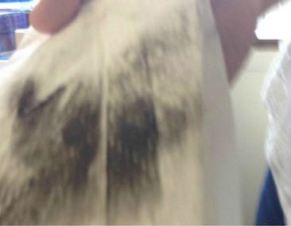
Isolation rooms at the Royal Liverpool University Hospital have become so heavily contaminated with silver nitrate that patients have complained, mistaking the black deposits on the windows for dirt. Director of nursing Lisa Grant admitted that the Hydrogen Peroxide Vapour (HPV) bio-decontamination system leaves a “sterile residue” but was apparently unaware that it is silver nitrate. The photo above was submitted to The Liverpool Echo by a patient who attempted to remove the chemical with a tissue. There is enough silver nitrate on the tissue to cause unpleasant chemical burns to the skin. Even more seriously, the AgNO3 dust levels in the room must have been far in excess of the legal maximum, which is an invisibly small 0.01mg/m³ – that’s 1/100,000th of a gram per cubic metre of air.

Rick Fentiman

Rick Fentiman claims to be a "Cambridge graduate microbiologist"

Prof. Wilson, UCLH


A letter published this week by Prof. Wilson of UCLH finally proves how Hygiene Solutions’ (Deprox) director Rick Fentiman cheated both the UCLH and rival HPV system manufacturer Bioquell Plc, in a widely publicized comparative test in 2015. The results of this test apparently demonstrated that the Deprox, vapourising a 5% Hydrogen peroxide solution had identical germicidal efficacy as the Bioquell system vapourising 35% hydrogen peroxide solution.

I published an article in 2016 in which I analyzed the test results as published by Professor Wilson and colleagues in the Journal of Hospital Infection, and concluded that Fentiman had in fact filled the internal tank of the Deprox machine with a 35% solution prior to the test. New data published in the letter proves this claim beyond reasonable doubt.

In Wilson’s original test, neither the aerial concentration of H2O2 vapour , or the concentration of the liquid solutions was  measured.

In response to widespread concern and comment as to the rather surprising results obtained, Wilson recently again obtained the use of a Bioquell and a Deprox system and measured the concentrations of both the liquid and aerial vapour phases throughout their test cycles, as detailed in this week’s letter.

The Deprox was using 5% H2O2 solution, and produced peak vapour concentrations of 29 to 46ppm. The Bioquell machine was using a 35% solution, and produced 450 to 640ppm of vapour.

The maximum aerial concentration of H2O2 that can be generated is limited by the concentration of the original solution. Henry’s law can be used to prove that about 50ppm is the maximum sustained aerial concentration that can be generated from a 5% solution. The figure of 46ppm for Deprox from Wilson’s retest of the machine is thus exactly what would be expected.

In the original comparative test, both the Deprox and the Bioquell systems demonstrated practically identical efficacies of log 5.1 for spores and log 6.3 for vegetative bacteria. A very large number of biological indicators of several species were used over multiple tests, and no significant difference in performance between the two systems was found.

Therefore, inescapably, both systems must have generated the same aerial concentration of H2O2 vapour, and that must have been in the region of 400 to 700ppm. (There are numerous published papers demonstrating a log 6 efficacy for HPV systems using 30-35% H2O2 solutions)

It is physically impossible to generate anything close to these levels of vapour by evaporating or aerosolizing a 5% solution. Quite apart from Henry’s law, the volume of water that would have to be evaporated along with the H2O2 would quickly push the relative humidity to saturation, and prevent further evaporation from taking place.

Therefore, in the original comparative tests as published in the Journal of Hospital Infection, the Deprox was NOT running on a 5% H2O2 solution as claimed, but on a 35% solution, the same as the Bioquell system.

How then was this deception accomplished?

There are some aspects of the way in which the original UCLH tests were conducted that  are very suggestive:

At the time of the tests, Hygiene Solutions had a contract with UCLH, and had 4 Deprox machines permanently on site, which were operated daily by Hygiene Solutions employees. UCLH had a definite rule that the equipment was not to be operated by their staff – hence no UCLH staff were trained in the use of the equipment.

The paper states:  “The HPS1 unit was operated by a trained engineer (Bioquell), while the HPS2 module was operated by hospital staff following training by a dedicated member of the issuing manufacturer (i.e. Hygiene Solutions).”

I have two independent witnesses that the two Deprox machines were used in the trial were not the machines already on site, but were specially prepared at the Kings Lynn depot, with all new piezo discs and calatytic deactivation media. The machines were driven up to UCLH personally by Rick Fentiman, who stayed for the duration of the tests then drove the machines back to Lynn. Apparently no other Hygiene Solutions staff were involved. The “dedicated member” therefore was Rick Fentiman, and he instructed and supervised some unidentified member of the “hospital staff” in the operation of the equipment “on the spot”.

The paper says: “However, during this study, both parties provided storage of equipment and hydrogen peroxide stock solutions off-site.” In the case of the Deprox units, this was  the large van in which they were transported. Clearly then there would have been opportunity for Mr Fentiman to have filled the internal storage tank of the test machines with a 35% solution and disposed of or diluted any residual fluid after the test, without either his own employees or the UCLH staff being aware of the substitution.
It is pertinent that (unknown to the UCLH) the Deprox has a substantial internal storage tank, of about 8 litres capacity.

capo2

Illustration from the Deprox patent.

The evaporation unit draws from the bottom of this tank, and the 2 litre Deproxin refill bottles trickle feed in to the top of the tank. I assume that for the sake of authenticity, a genuine Deproxin refill was inserted in to the top of the machine for the tests, hence even if Prof Wilson had tested the concentration of the fluid, he would have found it to be as stated. As concentrated H2O2 solution is substantially denser than water, a trickle of dilute solution in to the top of the tank would have no significant effect over the course of a few cycles of the machine.

TOM LISTER

Deprox salesman Tom Lister stalls when faced with a direct question about the UCLH tests. The machines had been filled with a 35% hydrogen peroxide solution, where UCLH were told it was a 5% solution. Tom knows this, and his guilty conscience shows very clearly in his body language and facial expressions. Rather than answer he says “Where did you say you were from?” although I had just told him, and was wearing a badge with the answer in large type!