
A comprehensive trial of the Hygiene Solutions Ltd Ultra-V decontamination system has exposed shocking discrepancies between the manufacturer’s claims and the actual performance of the system. Prof Peter Wilson, a consultant microbiologist at University College London Hospitals NHS Foundation (UCLH) tested the system against a variety of bacteria and spores using both contact plates and Biological Indicator discs. Six single patient isolation rooms were decontaminated and the results aggregated. The thorough in-vivo testing and the high reputation of the author and the UCLH Environmental Microbiology laboratory leave no doubt whatever as to the accuracy of the results.
Here are Hygiene Solutions’ claims, and the UCLH test results compared:
Claim:
Can achieve between a 6-log and a 4-log reduction of a broad spectrum of pathogens
Inactivates Clostridium difficile infection (C.diff.), Methicillin-resistant Staphylococcus aureus (MRSA) and Vancomycin-resistant Enterococci (VRE) even in light soiling
Test Result
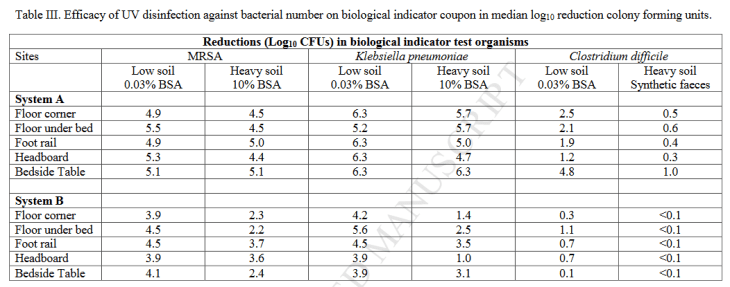
C. difficile spores in low soiling, log reductions between log 0.1 and log 1.1 (see Table III below)
Claim:
Placed in one central location within each room, Ultra-V can effectively decontaminate all surfaces in the enclosed healthcare area within the shortest treatment time.
Test Method
“Hygiene Solutions Ultra-V™: a single-emitter device (UVC, λ=265nm) relocated intermittently as determined by sensors in room.”
Claim:
How long does the process take? Average side room would normally take 20 minutes to complete.
Test Result
Process time, NOT including preliminary manual clean, 1 hour and 19 minutes. (See table 1 below)
Summary:
Hygiene Solutions claims imply a validated log 4 to 6 reduction of C. difficile, even in light soiling, on all surfaces in a single patient room in about 20 minutes – without moving the unit from a central location.
In reality, even with a 79 minute process time, and multiple relocations of the unit to eliminate shadowed areas, the greatest log reduction achieved for C.difficile spores was log 1.1. That is about ONE THOUSANDTH of the claimed performance – in spite of the process time being extended 4 fold.

Download the entire paper as a pdf:
S. Ali, S. Yui, M. Muzslay, A.P.R. Wilson
Or read the article on the Journal of Hospital Infection site:
http://www.journalofhospitalinfection.com/article/S0195-6701(17)30455-3/fulltext
 deproxfraud.info